Best Exercises for Lower Back Pain Relief at Home
Lower back pain affects up to 80% of Americans at some point in their lives — making it one of the most common reasons people visit a doctor and miss work. If you’ve been searching for exercises for lower back pain, you’re on the right track: research consistently shows that gentle, targeted movement is more effective than bed rest for most types of lower back pain. The key is knowing which movements help, which make things worse, and how to progress safely.
⚠️ Before you start: Consult your doctor or a licensed physiotherapist before beginning these exercises, especially if your pain is severe, was caused by an injury or fall, is accompanied by leg pain or numbness, or has lasted more than six weeks without improvement. This article provides general educational information — it is not a substitute for professional medical assessment.
Why Movement Helps Lower Back Pain
For decades, the default advice for lower back pain was rest. Current physical therapy research has largely reversed that guidance — and for good reason.
Prolonged bed rest causes the muscles supporting the spine to weaken and stiffen, reducing the blood flow that delivers nutrients to spinal discs and surrounding tissue. The result is a longer recovery and a higher likelihood of recurrence. Gentle movement, by contrast, increases circulation to the injured area, reduces muscle spasm, maintains range of motion, and gradually rebuilds the muscular support network that protects the spine.
The key muscles involved — the erector spinae (which run along either side of the spine), the multifidus (deep stabilizing muscles that attach directly to vertebrae), and the psoas (hip flexors that cross the lumbar spine) — all respond well to targeted low-load exercise and deteriorate noticeably with inactivity.
Physical therapy guidelines from organizations including the American Physical Therapy Association support early, gentle mobilization for most non-specific lower back pain. The exception: acute injuries involving possible fracture, disc herniation with neurological symptoms, or severe pain that limits any movement — these require professional evaluation before any exercise begins.
Exercises to Avoid If You Have Lower Back Pain
Before covering what helps, what to avoid matters equally — particularly for YMYL compliance and genuine reader safety.
Sit-ups and crunches — these flex the spine under load and significantly increase intradiscal pressure, which can aggravate disc issues and worsen pain. They’re not appropriate for most people with lower back pain regardless of how “functional” they look.
Standing toe touches — bending forward to touch the toes with straight legs places high shear force on the lumbar spine, particularly when performed quickly or repeatedly.
Heavy deadlifts without expert coaching — the hinge pattern itself is beneficial, but loading it incorrectly with an inflamed or injured back is a significant injury risk.
High-impact jumping exercises — burpees, jump squats, and box jumps create spinal compression forces that most people with acute lower back pain cannot tolerate safely.
Leg presses with excessive range — pushing the knees too far toward the chest under load stretches the lumbar spine in a loaded position, which can aggravate disc issues.
If an exercise in any section of this article creates sharp, shooting, or worsening pain — stop immediately and consult a healthcare professional before continuing.
10 Best Exercises for Lower Back Pain Relief
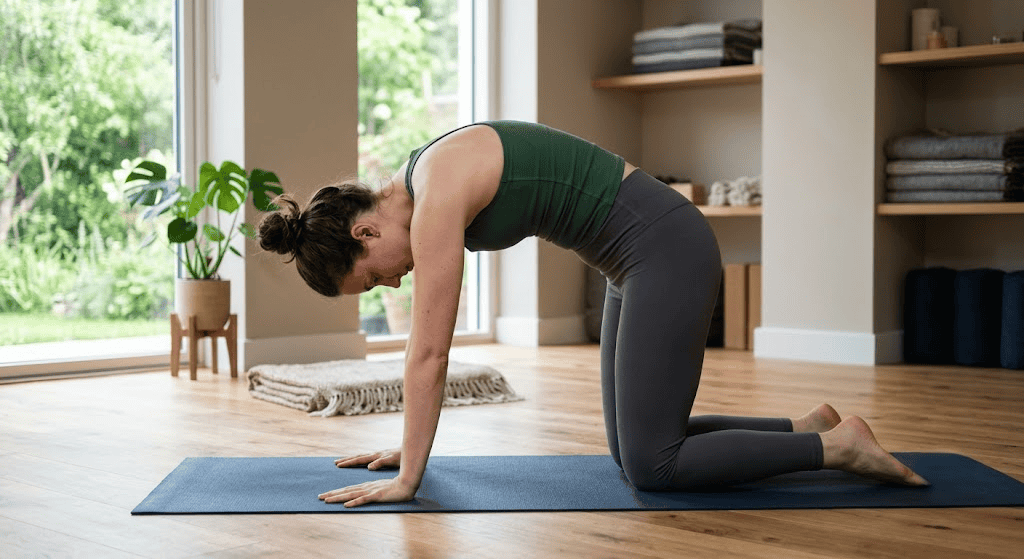
1. Cat-Cow StretchSets/Reps: 2 sets of 10 slow cycles | Target: Spinal mobility, multifidus, erector spinae
Start on hands and knees with wrists under shoulders and knees under hips. On a slow inhale, drop your belly toward the floor, lift your tailbone and chest toward the ceiling (cow position). On a slow exhale, round your spine toward the ceiling, tucking your pelvis and chin (cat position). Move fluidly between the two, letting the breath drive the movement. This gentle rhythmic mobilization is one of the first exercises most physiotherapists introduce for lower back pain because it moves the spine through its natural range without loading it.
Who should be cautious: People with cervical (neck) disc issues should keep the neck movement gentle. Those with significant lumbar stenosis may find extension (cow position) uncomfortable — stay within a pain-free range.
2. Child’s Pose
Sets/Duration: Hold 30–60 seconds, 3 times | Target: Lumbar decompression, hip flexors, thoracic spine
From a kneeling position, sit your hips back toward your heels and extend your arms forward on the floor, forehead resting on the ground. Allow your lower back to lengthen as gravity gently decompresses the lumbar spine. Breathe slowly and deeply — each exhale allows slightly more release. This is one of the most universally effective positions for relieving lower back compression and acute spasm.
Who should be cautious: People with knee problems may find kneeling uncomfortable — place a folded blanket under the knees or modify to a seated forward fold. Those with severe hip flexor tightness may find the hips don’t fully sink — support with a pillow between hips and heels.
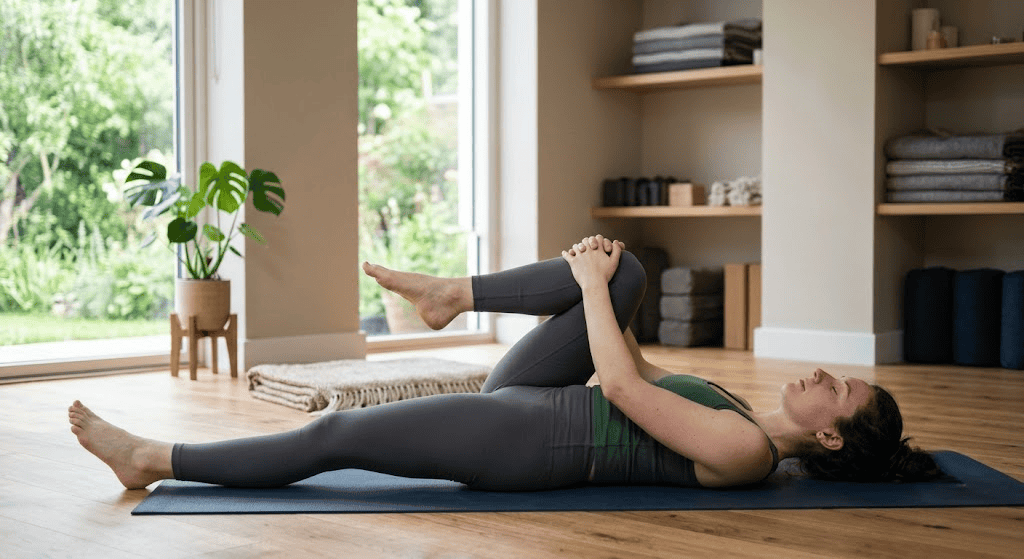
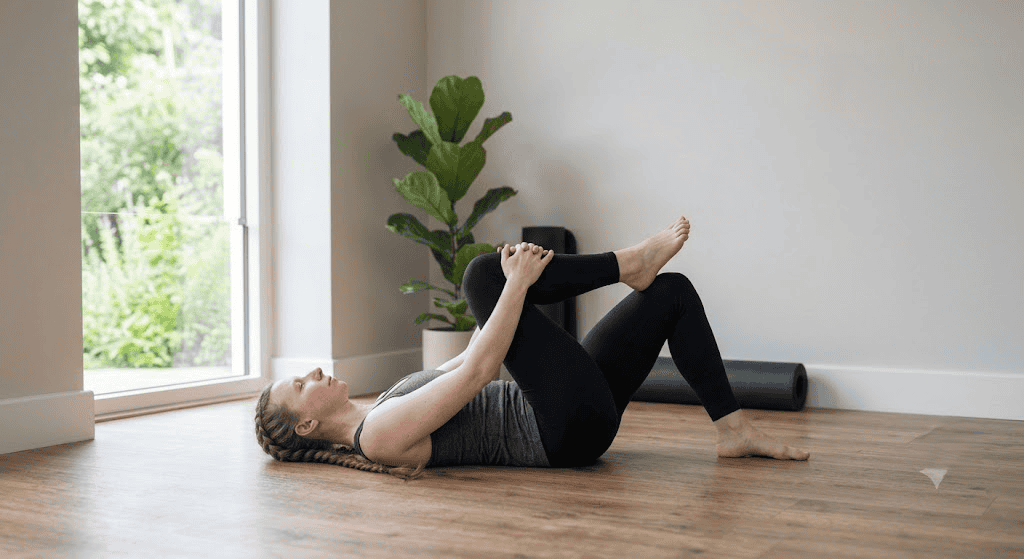
3. Knee-to-Chest Stretch
Sets/Duration: Hold 20–30 seconds each side, repeat twice | Target: Lower back, glutes, hip flexors
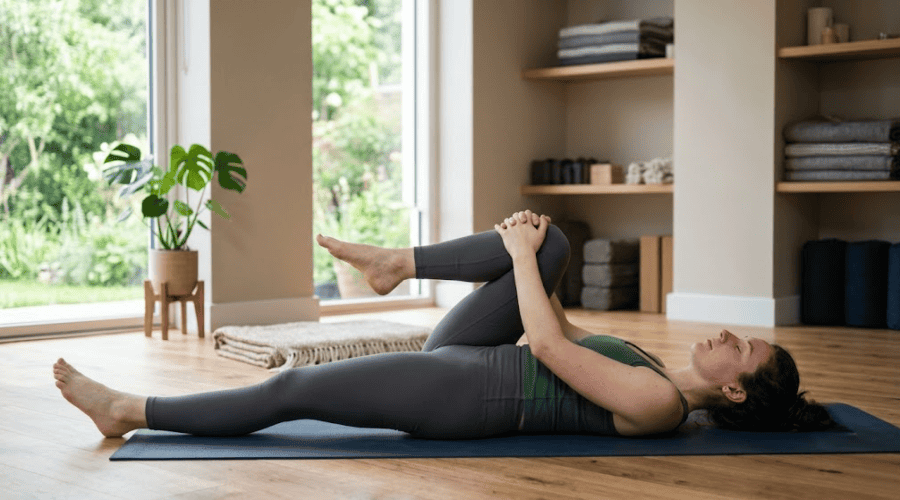
Lie on your back with knees bent and feet flat on the floor. Slowly draw one knee toward your chest, clasping your hands around the shin (not the knee cap) and gently pulling the knee closer. Hold, breathe, and feel the release in the lower back and glute on that side. Lower and repeat with the other leg. A double knee-to-chest (both knees drawn up simultaneously) provides a deeper lumbar stretch for those who tolerate it.
Who should be cautious: Avoid pulling aggressively — the stretch should be gentle, not forced. Those with hip replacement surgery should follow their surgeon’s post-operative movement restrictions.
4. Pelvic Tilts
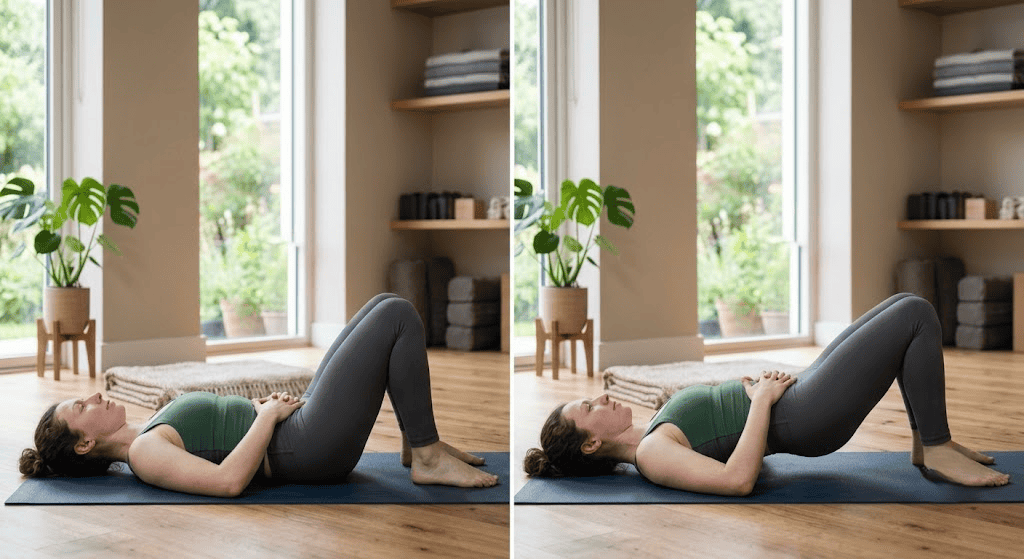
Sets/Reps: 2 sets of 15 reps | Target: Deep core stabilizers, lumbar muscles
Lie on your back with knees bent and feet flat on the floor. Gently flatten your lower back against the floor by tightening your abdominal muscles — imagine pulling your belly button toward the floor. Hold for 3–5 seconds, then release. This subtle movement activates the deep core stabilizers (particularly the transverse abdominis) that support the lumbar spine without any spinal loading or compression. It’s a foundational exercise used in physiotherapy for lower back rehabilitation.
Who should be cautious: This exercise is appropriate for nearly all lower back pain presentations. If it causes pain, reduce the range of motion or consult your physiotherapist.
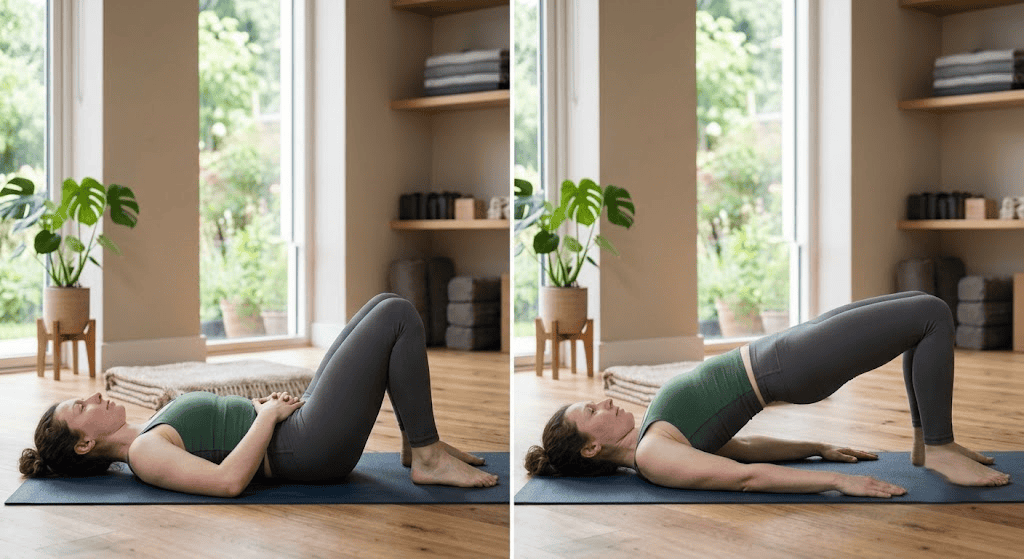
5. Glute Bridges
Sets/Reps: 3 sets of 12 reps | Target: Glutes, hamstrings, lower back stabilizers
Lie on your back with knees bent and feet flat on the floor, hip-width apart. Press through your heels to lift your hips off the floor until your body forms a straight line from shoulders to knees. Squeeze your glutes at the top, hold for 2 seconds, then lower slowly. Weak glutes are one of the primary contributing factors to lower back pain — they’re the primary force absorbers for the hips, and when they’re weak, the lumbar muscles compensate and become overloaded. Regular glute bridges directly address this imbalance.
Who should be cautious: Those with severe disc herniation should ensure the hip extension movement doesn’t reproduce radiating leg pain. Stop and consult your provider if it does.
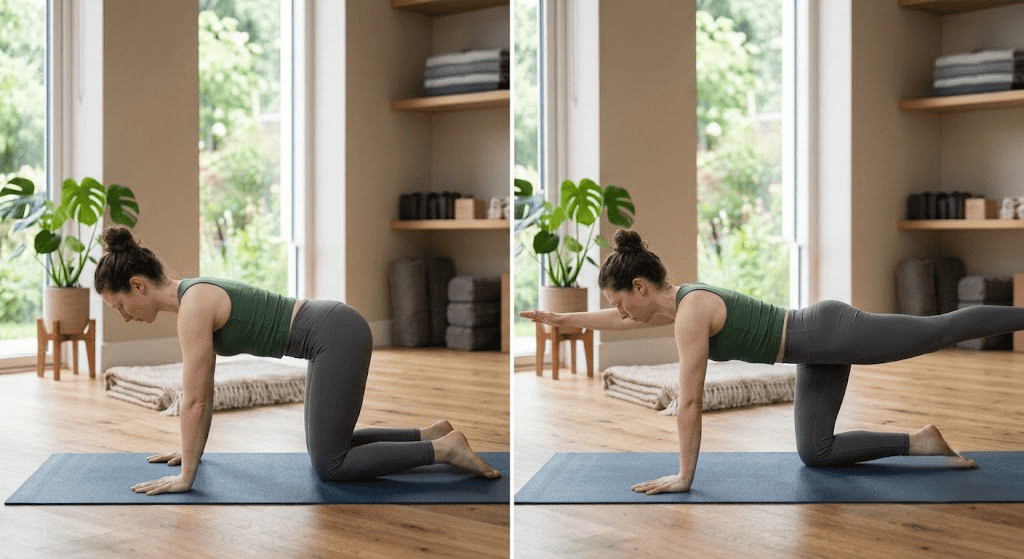
6. Bird-Dog
Sets/Reps: 3 sets of 8 reps each side | Target: Multifidus, erector spinae, core stabilizers
Start on hands and knees, spine neutral. Simultaneously extend your right arm forward and your left leg backward, keeping both parallel to the floor. Hold for 3–5 seconds, maintaining a stable, non-rotating pelvis. Return to start and repeat on the opposite side (left arm, right leg). The bird-dog builds the deep stabilizing muscles of the spine — particularly the multifidus — without compressing or loading it, making it one of the most widely recommended exercises in physiotherapy for lower back pain rehabilitation.
Who should be cautious: If the extended leg causes pain, try just the arm extension first, then add the leg as pain allows. Keep movements slow and controlled — speed reduces stability and the exercise’s effectiveness.
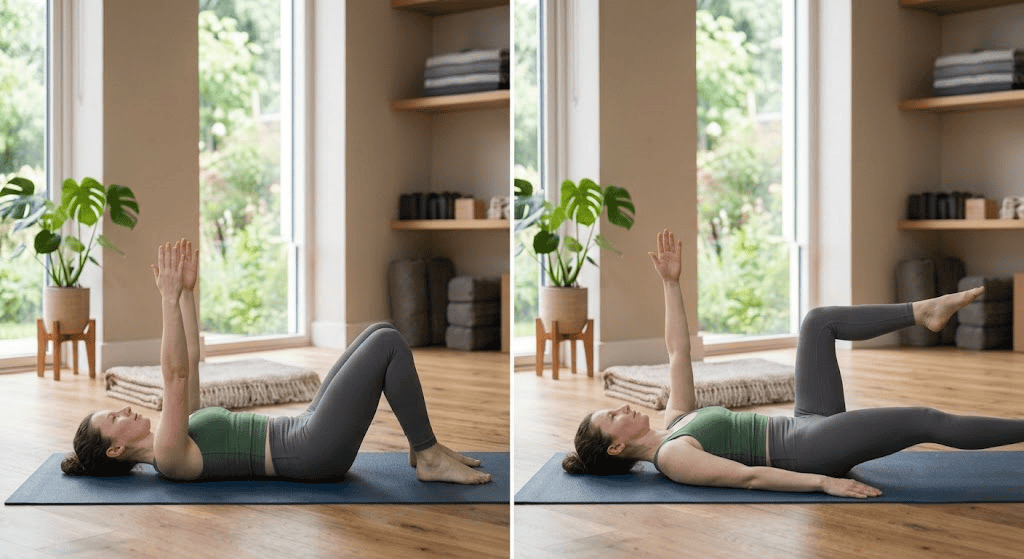
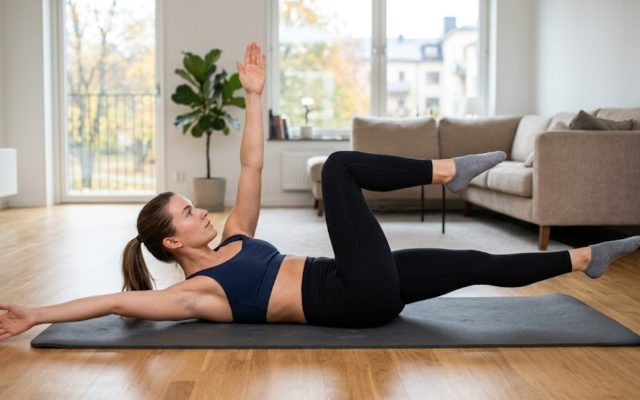
7. Dead Bug
Sets/Reps: 3 sets of 8 reps each side | Target: Transverse abdominis, lumbar stabilizers, hip flexors
Lie on your back with arms pointing toward the ceiling and knees bent at 90 degrees directly above your hips (tabletop position). Slowly lower your right arm behind your head while simultaneously extending your left leg toward the floor — stopping before your lower back arches off the ground. Return to start and repeat on the opposite side. The dead bug is one of the safest and most effective deep core exercises for people with lower back pain because it teaches the core to stabilize the spine against external forces — exactly what it needs to do in everyday life.
Who should be cautious: Never allow the lower back to arch off the floor — this loads the lumbar spine and defeats the exercise’s purpose. If you can’t control the arch, reduce the range of motion until you can.
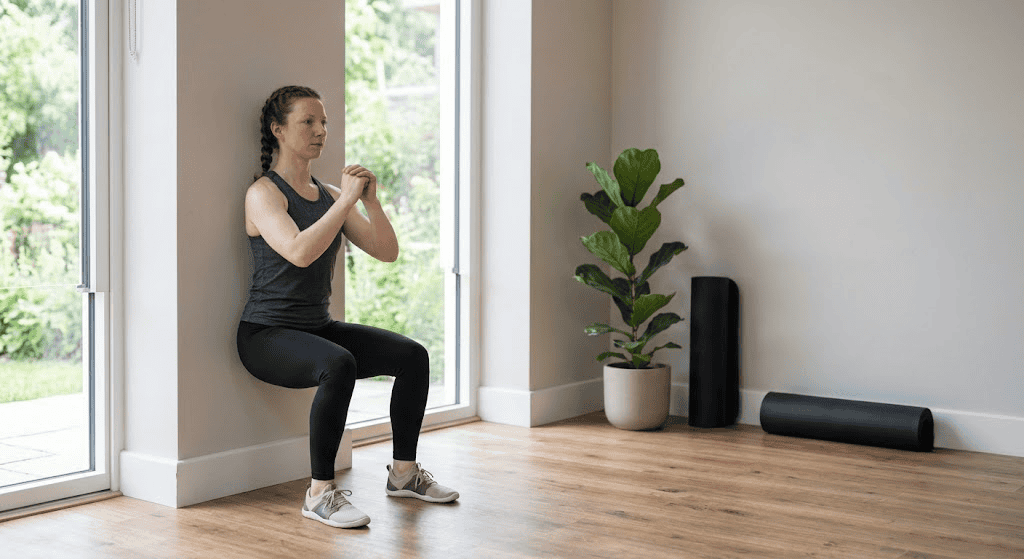
8. Wall Sits
Sets/Duration: 3 holds of 20–30 seconds | Target: Quadriceps, glutes, posterior chain
Stand with your back flat against a wall, feet 18–24 inches away from the wall. Slide your back down the wall until your thighs are approximately parallel to the floor (or as far as is comfortable), as if sitting in an invisible chair. Keep your lower back in contact with the wall throughout. Hold, then press through your heels to stand. Wall sits strengthen the quadriceps and glutes — the major lower body muscles that offload force from the lumbar spine during daily activities like standing, climbing stairs, and getting up from chairs.
Who should be cautious: Those with knee pain should not lower past the point of discomfort. Start with a shallower angle (less than 90 degrees) and progress over time.
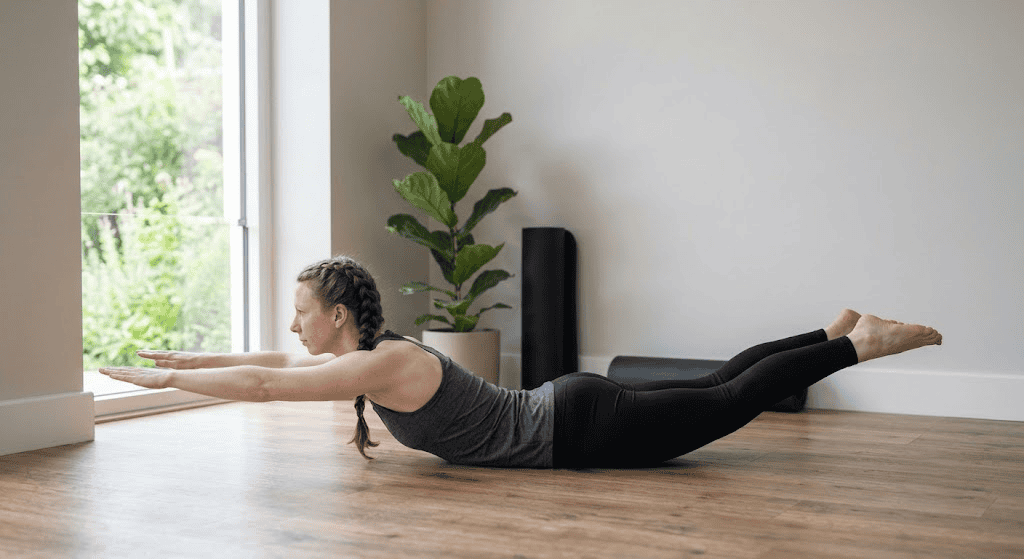
9. Superman Hold
Sets/Reps: 3 sets of 10 holds of 3–5 seconds | Target: Erector spinae, glutes, posterior chain
Lie face-down on the floor with arms extended overhead and legs straight. Simultaneously lift your arms, chest, and legs off the floor a few inches, squeezing your glutes. Hold for 3–5 seconds, then lower with control. The superman hold directly strengthens the erector spinae and multifidus — the muscles that run along the spine and are responsible for maintaining upright posture and resisting the forward-bending loads of daily life. Weakness in these muscles is a significant contributor to chronic lower back pain.
Who should be cautious: Those with lumbar stenosis or spondylolisthesis may find spinal extension painful — consult your physiotherapist before including this exercise. Start with very small lifts and increase range gradually.
10. Piriformis Stretch
Sets/Duration: Hold 30 seconds each side, twice | Target: Piriformis muscle, hip external rotators
Lie on your back with both knees bent. Cross your right ankle over your left knee, creating a figure-four shape. Either stay here (gentle version) or use your hands to pull your left thigh gently toward your chest, deepening the stretch in the right hip. The piriformis is a deep hip muscle that, when tight, can compress the sciatic nerve and refer pain into the lower back and buttock — the pattern commonly mistaken for disc-related sciatica. Stretching it regularly is one of the most effective interventions for piriformis syndrome and contributes meaningfully to overall lower back pain relief.
Who should be cautious: If this position reproduces radiating leg pain, stop and consult your provider. True disc-related sciatica can worsen with certain hip positions.
How to Build a Daily Back Pain Relief Routine
Consistency matters more than any individual exercise. Here’s a realistic daily structure:
Morning routine (5 minutes): Cat-cow (10 cycles) → Child’s pose (60 seconds) → Knee-to-chest stretch (30 seconds each side) → Pelvic tilts (15 reps). Do this before getting out of bed or within the first 10 minutes of waking. Morning stiffness is when these mobilizations make the most immediate difference.
Desk break routine (2 minutes): Set a timer for every 60–90 minutes. Stand up, do 10 pelvic tilts, 10 glute squeezes while standing, and 30 seconds of gentle walking in place. This breaks the static loading pattern that accumulates across a sitting workday.
Evening routine (5 minutes): Glute bridges (12 reps) → Bird-dog (8 each side) → Dead bug (8 each side) → Piriformis stretch (30 seconds each side) → Child’s pose (60 seconds to finish). The strengthening exercises are better timed for later in the day when muscles are warmer and more pliable.
Lifestyle Changes to Prevent Lower Back Pain
Ergonomic desk setup: Screen at eye level, lower back supported by chair or lumbar pillow, feet flat on the floor. Forward head posture and unsupported lumbar sitting are among the most consistent drivers of desk worker lower back pain.
Sleep position: Sleeping on your side with a pillow between your knees maintains neutral spinal alignment and significantly reduces overnight lumbar stress. On your back, a pillow under the knees achieves the same effect. Sleeping face-down is the most problematic position for lower back pain.
Maintain a healthy weight: Each pound of excess weight increases compressive load on the lumbar spine. Even modest weight reduction through diet and low-impact activity reduces the mechanical stress on lumbar discs and facet joints.
Strengthen your core consistently: The exercises above are a starting point. A consistent core strengthening habit — even 10 minutes three times per week — builds the muscular support system that prevents recurrence.
Stay active: Walking remains one of the best evidenced interventions for chronic lower back pain. Regular walking maintains spinal mobility, glute and hamstring strength, and the cardiovascular health that supports recovery.
Frequently Asked Questions
What is the fastest way to relieve lower back pain? For acute lower back pain, a combination of gentle movement (cat-cow, knee-to-chest stretches), a short period of relative rest (avoiding the activities that aggravate it), heat application to the lower back, and over-the-counter anti-inflammatory medication (if appropriate for you and approved by your doctor) provides the fastest initial relief. Avoid lying completely still — even gentle walking around the house maintains blood flow and prevents the stiffness that prolongs acute episodes. If pain is severe or accompanied by leg numbness or weakness, seek medical attention rather than home treatment.
Should I exercise with lower back pain? For most non-specific lower back pain — the kind caused by muscle strain, poor posture, or prolonged sitting — gentle exercise is not only safe but recommended by physical therapy guidelines. The exercises in this guide are specifically chosen for their safety profile and effectiveness for common lower back pain presentations. The exception: sharp pain caused by a known injury, pain that radiates down the leg (possible disc involvement), or pain accompanied by bladder/bowel changes requires professional evaluation before any exercise begins.
What exercises make lower back pain worse? Sit-ups, crunches, standing toe touches, and heavy spinal loading exercises consistently worsen most lower back pain presentations by increasing disc pressure or shear forces on the lumbar spine. High-impact jumping, unsupported forward bending, and exercises that require holding a bent-spine position under load are similarly problematic for most lower back pain sufferers. This is why the exercise selection in this guide deliberately avoids spinal flexion under load and focuses on neutral-spine strengthening and gentle mobility work.
How long does lower back pain take to heal? Acute lower back pain — sudden onset from a strain or awkward movement — typically resolves within 2–6 weeks with appropriate movement, rest, and care. Chronic lower back pain (lasting more than 12 weeks) requires a more systematic approach and often benefits from working with a physiotherapist who can identify the specific structural and movement factors contributing to your individual presentation. Most people experience meaningful improvement within 4–8 weeks of consistent therapeutic exercise, though full resolution of chronic pain can take several months.
Can stretching fix lower back pain? Stretching alone addresses flexibility and muscle tension but not the muscular weakness that is usually the underlying cause of chronic lower back pain. The most evidence-backed approach combines mobility work (stretching, cat-cow, child’s pose) with targeted strengthening (glute bridges, bird-dog, dead bug) that rebuilds the core and posterior chain support system. Stretching tight muscles without strengthening the weak ones that forced them into tightness in the first place is a common reason people experience temporary relief from stretching but ongoing recurrence of pain.
Moving Toward a Pain-Free Back
Exercises for lower back pain work — but they work gradually, and they work best when chosen carefully, performed consistently, and supervised professionally if your pain is significant. The ten exercises in this guide represent a physiotherapy-informed foundation for most non-specific lower back pain presentations. Start with the gentlest options (cat-cow, child’s pose, knee-to-chest), add the strengthening exercises as pain allows, and build the daily routine around your schedule.
The back that feels good in six months is the one that was moved gently today, moved again tomorrow, and kept moving consistently even when it didn’t feel urgent to do so.
This article is for informational and educational purposes only and does not constitute medical advice, diagnosis, or treatment. Lower back pain has many potential causes, some of which require medical evaluation and treatment beyond exercise. Consult your doctor or a licensed physiotherapist before starting these or any other exercises, particularly if your pain is severe, was caused by injury, is accompanied by leg pain or numbness, or has not improved with rest. Stop any exercise that causes or worsens pain and seek professional guidance.
Leave a Comment