Best Morning Stretches to Start Your Day Right
You know that stiff, groggy feeling when you first wake up — where your back feels locked, your hips are tight, and getting out of bed feels like more effort than it should? Morning stretches are the simplest possible fix, and they take less time than brewing coffee. A 5–10 minute stretching routine done before you leave your bedroom can meaningfully change how your body feels and how your brain functions for the rest of the day. No gym, no equipment, no experience needed — just a mat or your bed and a few minutes of intentional movement.
This guide covers the twelve most effective morning stretches, two ready-to-use routines (five minutes and ten minutes), and the habit strategies that make it actually stick beyond week one.
Why Morning Stretching Matters
During sleep, your body is largely still for 6–9 hours. Your muscles shorten and tighten as they relax, synovial fluid (the lubricating fluid in your joints) becomes less distributed, and your connective tissue cools and stiffens. It’s completely normal — but it means that waking up and immediately asking your body to perform without any warm-up creates unnecessary strain on muscles and joints that aren’t ready for the load.
Morning stretching counteracts all of this. It increases blood flow to muscles that have been resting, restoring warmth and pliability. It redistributes synovial fluid through your joints, reducing the creaking and stiffness that makes movement uncomfortable early in the day. It improves range of motion and helps reset your posture before hours at a desk can reinforce the rounded-shoulder, forward-head pattern most adults develop.
There’s a mood component too. Gentle movement in the morning increases serotonin release, and the deliberate breathing that accompanies stretching activates the parasympathetic nervous system — reducing the cortisol spike that many people experience immediately on waking. Research on morning movement habits consistently shows that people who incorporate stretching report better energy levels, improved mood, and reduced feelings of stiffness throughout the day.
How Long Should You Stretch in the Morning?
The honest answer: even five minutes is meaningfully beneficial if done consistently. Perfect is the enemy of consistent here.
5 minutes: Enough to run through the six essential stretches that cover the lower back, hips, spine, and shoulders — the areas that suffer most from sleep and prolonged sitting.
10–15 minutes: The full routine that addresses flexibility, posture, and mobility more comprehensively. More appropriate on less rushed mornings or weekends.
Hold each stretch for 20–30 seconds. This is the minimum time needed for the nervous system to “allow” the muscle to lengthen — anything shorter keeps the protective reflex partially activated.
Don’t bounce. Morning muscles are cool and less pliable than they’ll be later in the day — static (still) stretching is safer and more effective than dynamic or ballistic stretching first thing. Save bouncy or fast movements for after you’ve been moving for 20+ minutes.
Breathe deeply throughout. Each exhale creates a natural muscular relaxation that allows you to deepen a stretch gently. Holding your breath tightens everything.
12 Best Morning Stretches
1. Full Body Stretch in Bed
Duration: 30 seconds | Target: Full body, spine, calves
Before you even sit up: extend both arms overhead toward your headboard, point your toes away from you, and stretch your entire body long — like a full-body yawn. Hold for 30 seconds, breathing deeply. This gentle traction decompresses the spine and tells your nervous system that movement is beginning. It’s the perfect first stretch because you do it before getting out of bed, eliminating the friction of starting.
Modification: If pointing toes is uncomfortable, flex your feet instead (toes toward the ceiling).

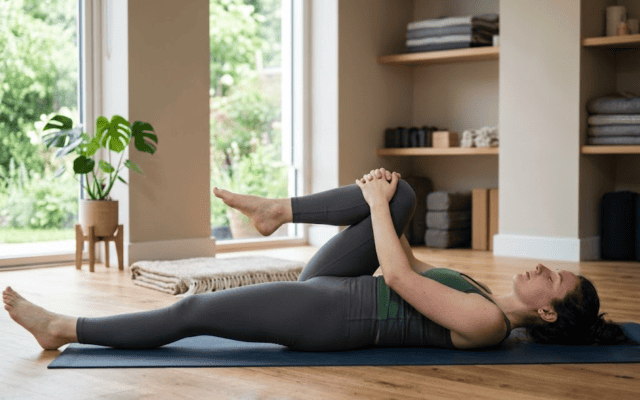
2. Knee to Chest
Duration: 30 seconds each side | Target: Lower back, glutes, hip flexors
Still lying on your back: draw one knee gently toward your chest, clasping your hands around the shin (not the knee cap). Hold for 30 seconds, breathing into the lower back. Switch sides. This stretch releases the lumbar muscles that tighten overnight and decompresses the sacroiliac joint — one of the most common sources of the morning lower back ache that makes the first few steps feel painful. Double knee-to-chest (both knees drawn up simultaneously) provides a deeper lumbar release.
Modification: Hold behind the thigh rather than the shin for less knee pressure.

3. Supine Spinal Twist
Duration: 30–45 seconds each side | Target: Thoracic and lumbar spine, obliques, IT band
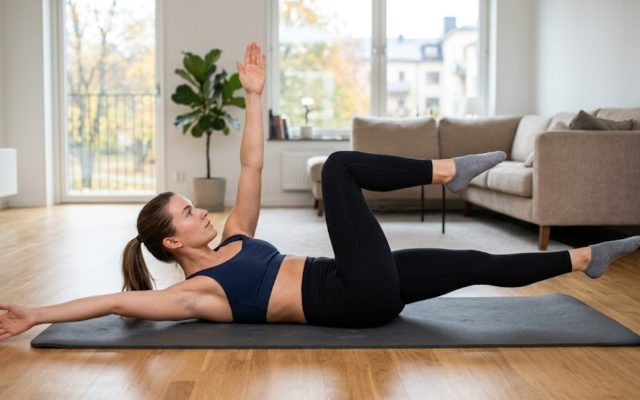
Lying on your back, draw your right knee to your chest, then let it fall across your body to the left — stacking your right hip over your left. Extend your right arm out to the side and turn your gaze right if comfortable. Keep both shoulders on the floor. Breathe and allow gravity to deepen the twist for 30–45 seconds. Repeat on the other side. This stretch releases the thoracic rotation that sitting compresses, and it’s one of the most satisfying stretches you can do for that “crack” feeling that means tension is releasing.
Modification: Keep the knee lower if the hip-stack position is too intense.

4. Cat-Cow
Duration: 10 slow cycles | Target: Entire spine, multifidus, erector spinae
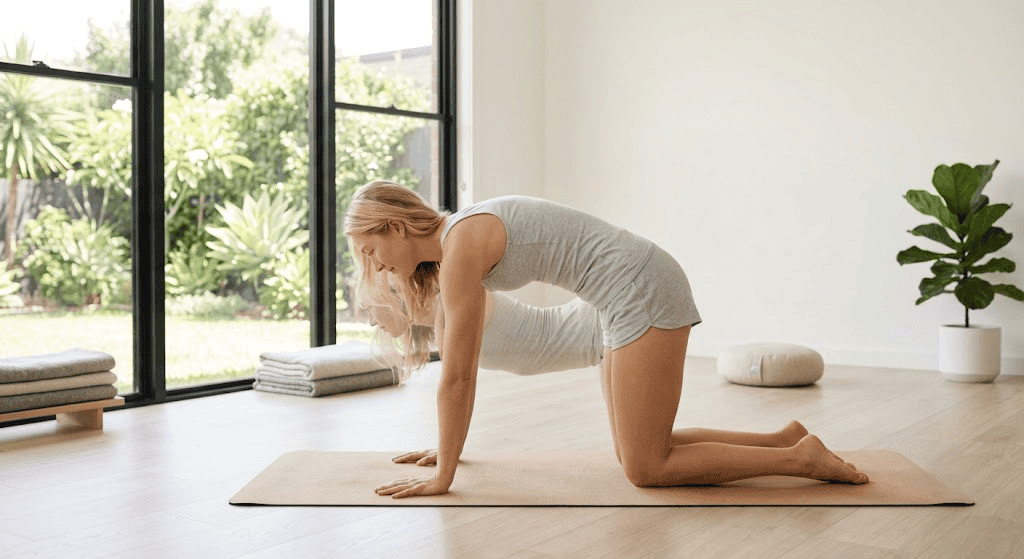
Move to the floor on hands and knees, wrists under shoulders, knees under hips. On an inhale, drop your belly toward the floor and lift your head and tailbone (cow). On an exhale, round your spine to the ceiling and tuck chin and pelvis (cat). Move slowly and let your breath lead — the goal is spinal mobility, not speed. Ten cycles take about 60 seconds and produce a remarkable amount of relief in a stiff spine. This is a physiotherapy staple for lower back mobility for good reason.
Modification: Can be done seated in a chair by arching and rounding the lower back alternately.
5. Child’s Pose
Duration: 45–60 seconds | Target: Lower back, hip flexors, thoracic spine, lats
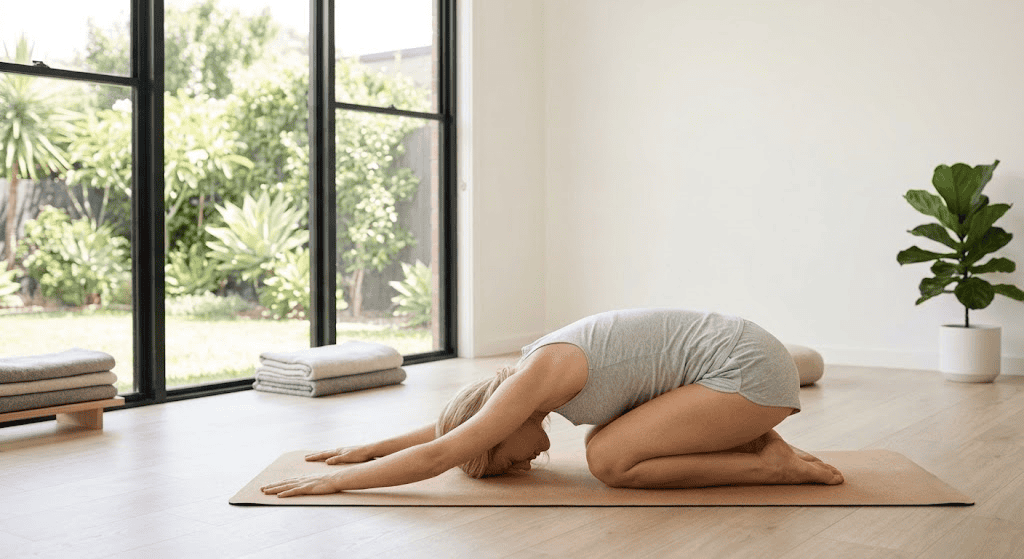
From hands and knees, push your hips back toward your heels and reach your arms forward on the floor, forehead resting down. Breathe deeply into your lower back — each inhale expands the back body; each exhale lets you settle a little further. This gentle spinal decompression is one of the most universally accessible stretches and one of the most effective for the lower back tension accumulated during sleep.
Modification: Place a folded blanket between your hips and heels if they don’t comfortably meet. Widen the knees for more hip flexor release.
6. Downward-Facing Dog
Duration: 30–60 seconds | Target: Hamstrings, calves, spine, shoulders, full posterior chain
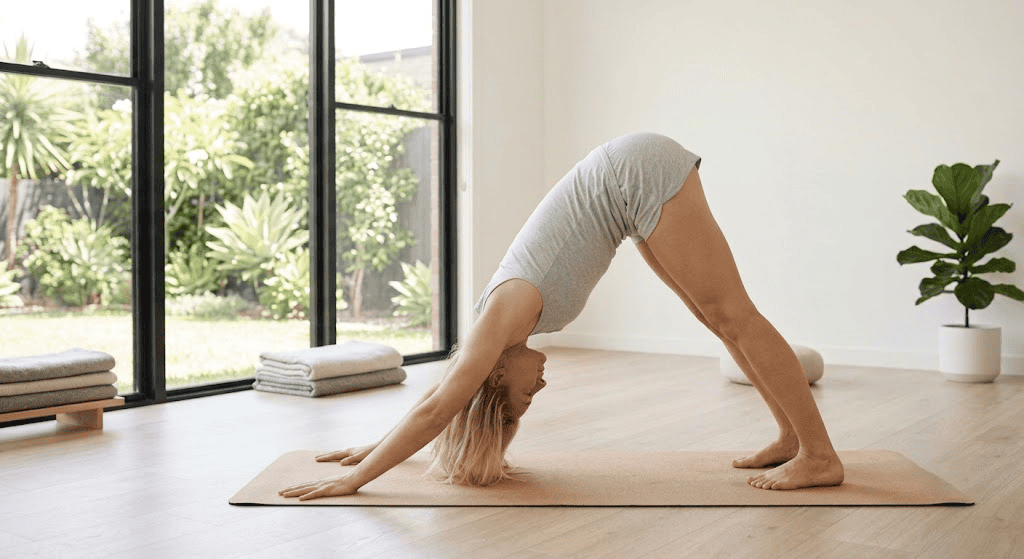
From child’s pose, tuck your toes and press up and back, straightening your legs as much as comfortable and pushing your hips toward the ceiling. Press your hands firmly into the floor, rotate your upper arms outward, and let your head hang between your arms. Pedal your heels alternately to warm up the calves. Downward dog is one of the most complete single stretches available — it addresses the entire posterior chain (back of the body) simultaneously.
Modification: Keep knees generously bent if hamstrings are tight. The priority is a long, straight spine — bent knees achieve that better than straight legs with a rounded back.
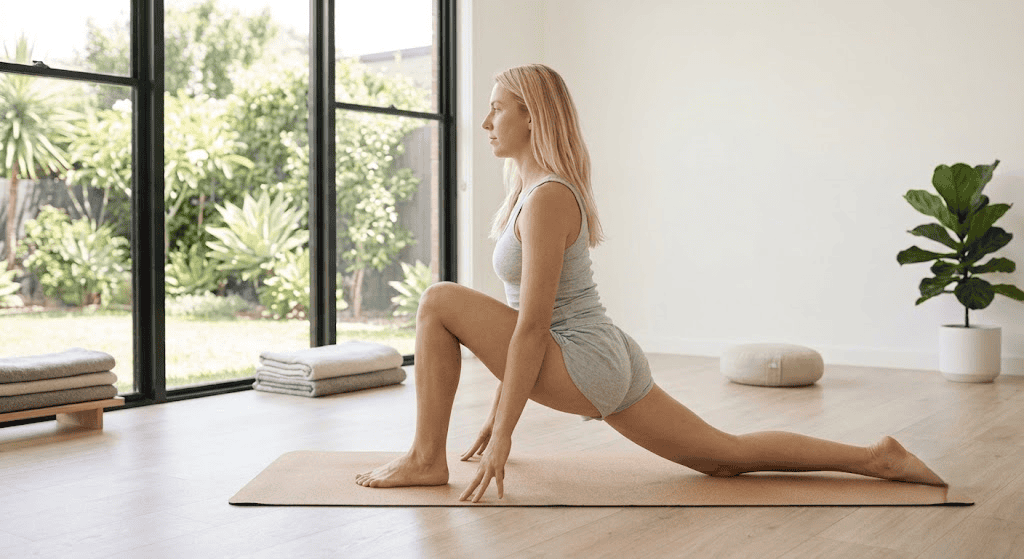
7. Hip Flexor Lunge Stretch
Duration: 30–45 seconds each side | Target: Hip flexors (psoas and iliacus), quadriceps
Step your right foot forward into a low lunge, dropping your left knee to the floor. Shift your weight slightly forward until you feel a stretch in the front of the left hip. Keep your torso upright rather than leaning forward. This is the most important stretch for anyone who sits for extended periods — the hip flexors shorten and tighten during sitting, pulling the pelvis into an anterior tilt that directly strains the lower back. Stretching them in the morning counters the effect before it accumulates.
Modification: Place a folded blanket under the back knee for cushioning.
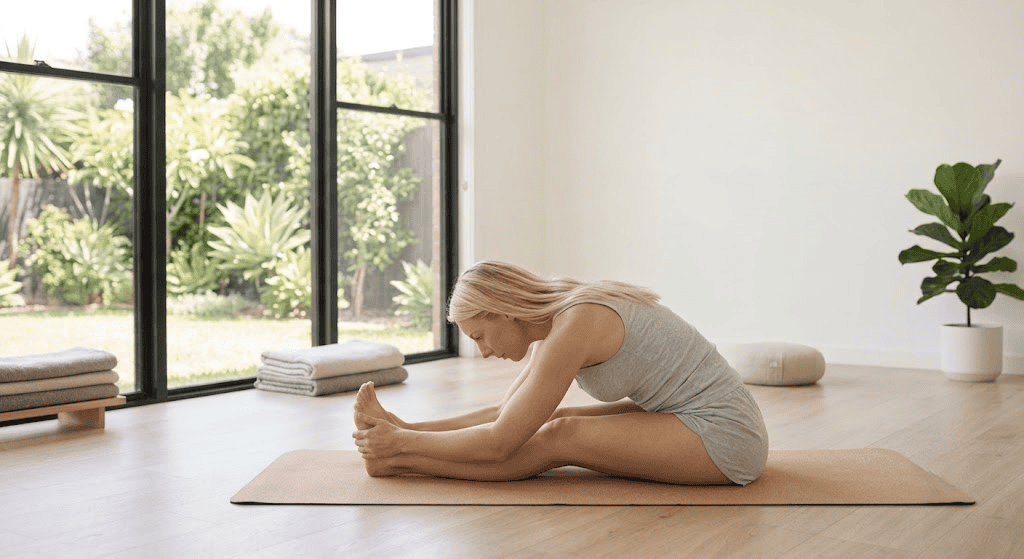
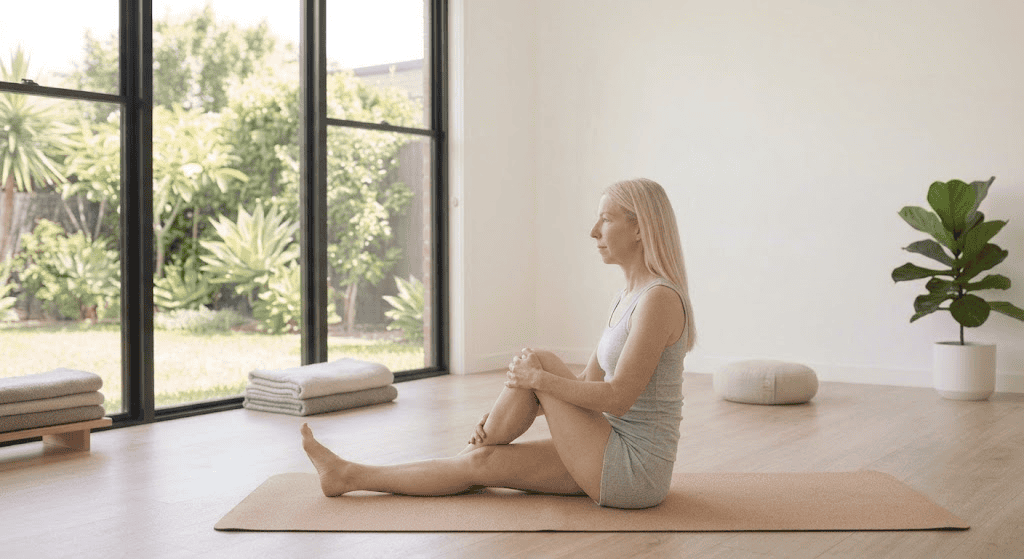
8. Seated Forward Fold
Duration: 30–45 seconds | Target: Hamstrings, calves, lower back
Sit on the floor with both legs extended straight ahead. Sit tall and hinge forward from your hips (not your waist), reaching toward your feet. Hold your shins, ankles, or feet depending on your flexibility. Let your head hang. The key is hinging from the hips to maintain a long spine — rounding heavily from the lower back reduces the hamstring stretch and can stress the lumbar discs. Tight hamstrings are a major contributor to lower back tension; this stretch addresses both simultaneously.
Modification: Sit on a folded blanket to reduce posterior pelvic tilt. Bend your knees slightly if straight legs cause the lower back to round excessively.
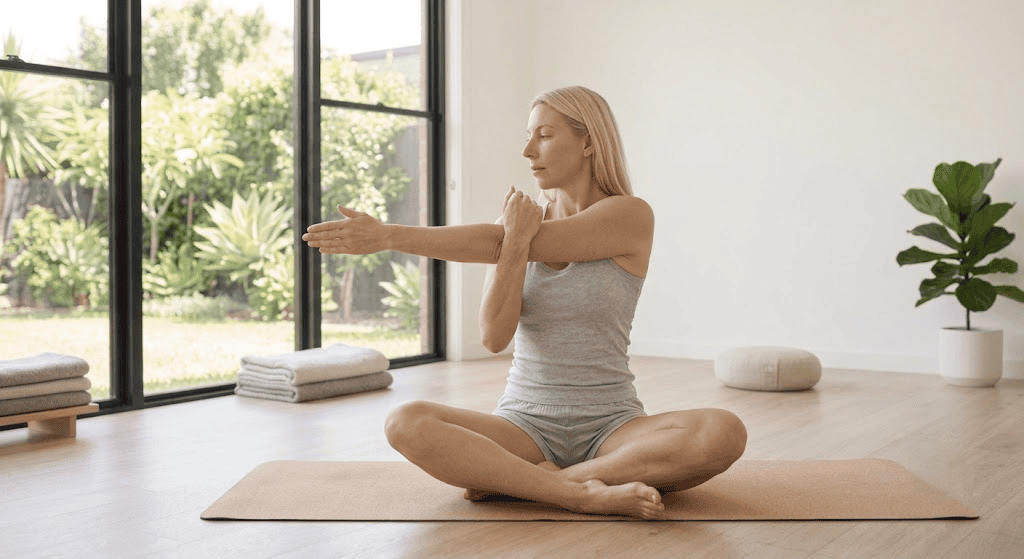
9. Cross-Body Shoulder Stretch
Duration: 20–30 seconds each side | Target: Posterior shoulder, rhomboids, upper back
Standing or sitting, bring your right arm across your body at shoulder height. Use your left hand to gently press it closer to your chest. Hold and breathe. The posterior shoulder and upper back muscles chronically tighten with desk work and forward-head posture — this stretch directly releases that pattern and helps reset shoulder position for the day.
Modification: This stretch can be performed seated or lying down if needed.
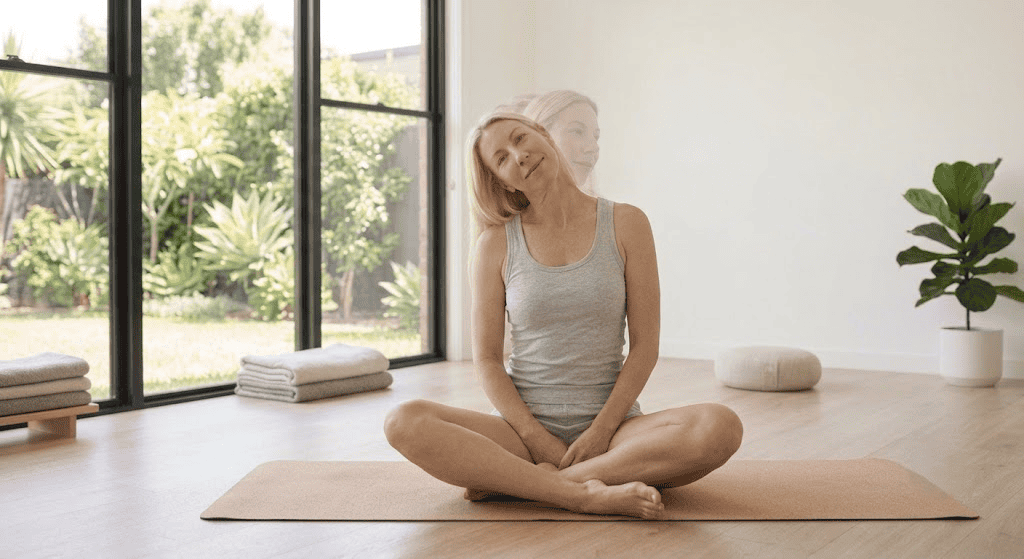
10. Neck Rolls
Duration: 60 seconds | Target: Cervical spine, upper trapezius, neck extensors
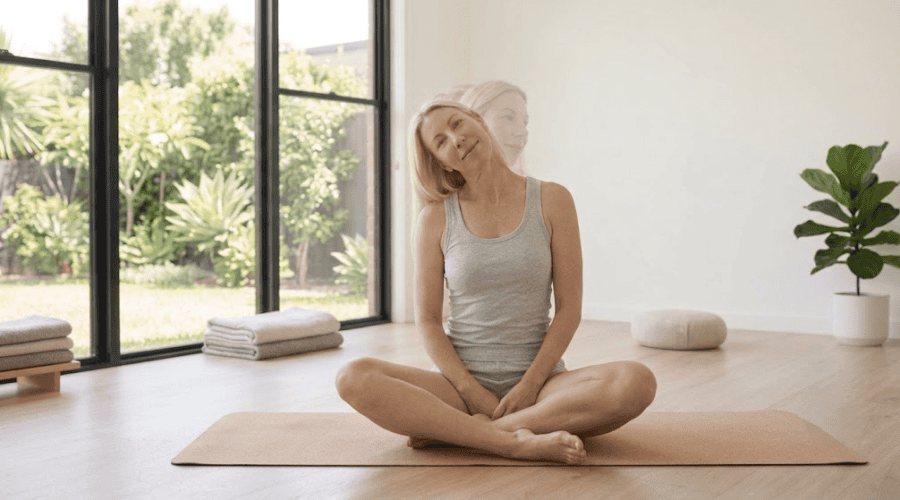
Standing or seated, slowly drop your right ear toward your right shoulder and hold for a breath. Roll your chin gently toward your chest, pause, then continue to the left shoulder. Move slowly — neck muscles are sensitive and should be stretched gently, particularly in the morning when they’re cool. Avoid rolling the head backward, which can compress the cervical vertebrae. Three to four gentle, slow rolls in each direction is sufficient.
Modification: Reduce the range of motion if any position causes tingling or pain. Neck symptoms that include radiating arm pain should be evaluated by a physiotherapist before any stretching.
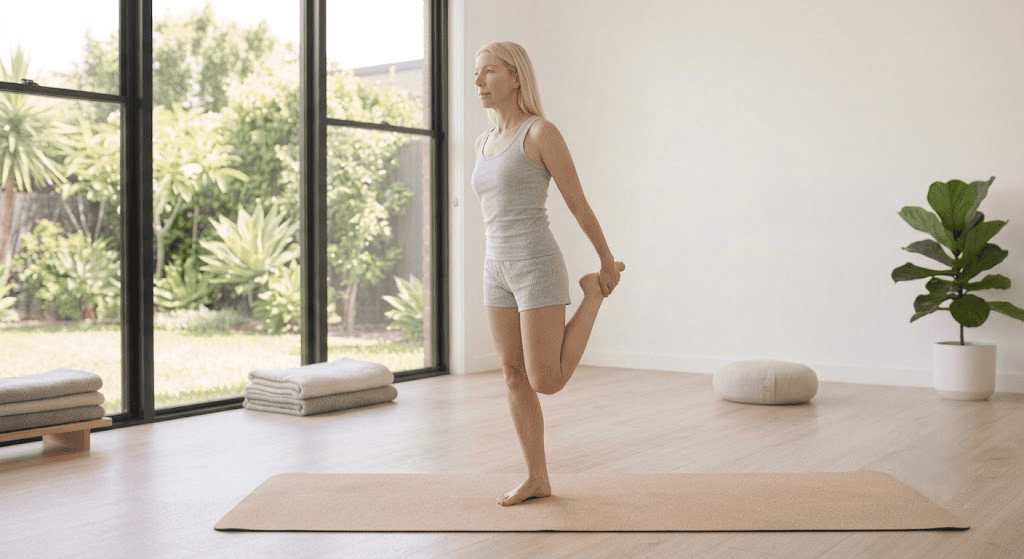
11. Standing Quad Stretch
Duration: 20 seconds each side | Target: Quadriceps, hip flexors
Stand near a wall for balance. Bend your right knee and bring your right heel toward your right glute, holding your ankle with your right hand. Stand tall — don’t let your hip flex forward (pushing the knee behind you deepens the quad stretch). Hold 20 seconds, switch sides. The quadriceps are among the most frequently tight muscles in desk workers and contribute directly to hip flexor tension that affects lower back comfort.
Modification: Loop a towel around your ankle if you can’t reach your foot comfortably.
12. Figure-4 Stretch (Piriformis Stretch)
Duration: 30–45 seconds each side | Target: Glutes, piriformis, hip external rotators
Lie on your back with both knees bent. Cross your right ankle over your left knee, creating a figure-4 shape. Either hold here (mild version) or draw your left knee gently toward your chest to deepen the stretch in the right hip. The piriformis — a deep hip muscle — is frequently tight in people who sit for extended periods and can contribute to both hip pain and radiating buttock discomfort. Regular morning stretching of this muscle is one of the most reliably effective things you can do for hip and lower back comfort.
Modification: If lying down is uncomfortable, perform the figure-4 in a seated position on the edge of a chair.
5-Minute Morning Stretch Routine (Quick Version)
For busy mornings, do these six stretches in sequence:
- Full body stretch in bed — 30 seconds
- Knee to chest — 30 seconds each side (60 seconds total)
- Supine spinal twist — 30 seconds each side (60 seconds total)
- Cat-Cow — 10 slow cycles (approximately 60 seconds)
- Child’s pose — 45 seconds
- Hip flexor lunge stretch — 30 seconds each side (60 seconds total)
Total: approximately 5 minutes. Do this before getting out of bed and in the first five minutes on the floor.
10-Minute Morning Stretch Routine (Full Version)
For mornings with more time, work through all twelve stretches in this sequence:
- Full body stretch in bed — 30 sec
- Knee to chest — 30 sec each side
- Supine spinal twist — 40 sec each side
- Cat-Cow — 10 cycles
- Child’s pose — 45 sec
- Downward dog — 45 sec
- Hip flexor lunge — 35 sec each side
- Seated forward fold — 40 sec
- Cross-body shoulder stretch — 25 sec each side
- Neck rolls — 60 sec
- Standing quad stretch — 20 sec each side
- Figure-4 stretch — 40 sec each side
Total: approximately 10 minutes. This sequence flows naturally from floor to standing, following the body’s natural warm-up progression.
Tips to Make Morning Stretching a Habit
Start before you get out of bed. Stretches 1–3 and the figure-4 can all be done lying down. Starting while you’re still horizontal removes the friction of rolling out of bed, setting up a mat, and “starting” the routine. You’ve already started.
Keep your mat next to your bed. Environmental design beats motivation every time — if the mat is already out and already there, you’ll use it. If it’s rolled up in a closet, you won’t.
Pair it with an existing morning anchor. Do your five-minute routine while your coffee brews, or immediately after your alarm goes off. Habit stacking — attaching a new behavior to an existing one — is the most reliable method for building routines that persist.
Start with just three stretches. The full body stretch, knee to chest, and cat-cow take under three minutes and cover the essentials. Committing to those three daily for two weeks builds the habit; adding more later is easy once the pattern is established.
Track your streak. A simple checkmark on a paper calendar or in a habit tracking app creates a visual streak that many people find surprisingly motivating to maintain. The goal isn’t perfection — missing one day is fine. Missing two in a row is the pattern that breaks habits.
Frequently Asked Questions
Is it good to stretch first thing in the morning? Yes — for most people, morning stretching is one of the most beneficial habits available for daily comfort and long-term mobility. Muscles are tight after sleep and joints are stiff from inactivity; gentle stretching addresses both and prepares the body for the movement demands of the day. The exception: people with certain injuries or conditions (disc herniation, acute muscle strain) should confirm with their physiotherapist which morning stretches are appropriate for their specific situation before starting.
Should I stretch before or after breakfast? Either works — morning stretching at low intensity doesn’t require fueling the way a workout would. Most people find stretching before breakfast most practical (it’s part of the wake-up sequence rather than something to schedule later), but if you feel lightheaded or low energy first thing, a small glass of water or a piece of fruit before starting is a fine adjustment.
Can morning stretching help with back pain? For non-specific lower back pain — the most common kind, often caused by prolonged sitting, poor posture, or overnight muscle tightening — morning stretching can meaningfully reduce pain and stiffness when practiced consistently. The cat-cow, knee-to-chest, child’s pose, and hip flexor lunge stretch in this guide are specifically included for their effectiveness in lower back pain relief. If your back pain is caused by a diagnosed condition (disc herniation, stenosis, spondylolisthesis), consult a physiotherapist before beginning any routine.
What happens if you stretch every morning? With consistent daily morning stretching over four to eight weeks, most people experience: noticeably reduced morning stiffness, improved flexibility and range of motion, better posture (particularly in the shoulders and hips), reduced lower back tension, and a more energized start to the day. Over several months, regular stretching also reduces injury risk by maintaining healthy muscle length and joint mobility. The improvements are cumulative — the difference between week one and month three is substantial.
Is 5 minutes of stretching enough? Five minutes done consistently is dramatically more effective than fifteen minutes done occasionally. The five-minute routine in this guide covers the six highest-priority stretches for morning stiffness — lower back, spine, hips, and shoulders. It’s enough to meaningfully reduce stiffness and improve how your body feels for the rest of the day. As the habit becomes established, extending to ten minutes is natural and easy — but starting with five and doing it daily is always the right priority.
Make the First Five Minutes Count
Morning stretches are one of the highest-return habits available — a few minutes of gentle, deliberate movement that changes how your body feels and functions for the entire day. Start with the five-minute quick routine tomorrow morning, do it before you get out of bed, and keep your mat where you can see it. By week three, it won’t feel optional anymore — it’ll feel like the obvious way to begin the day.
People with existing injuries or chronic pain conditions should consult a physiotherapist before starting any new stretching routine to ensure the movements are appropriate for their specific situation.
Leave a Comment