Best 20-Minute Home Workout for Beginners (No Equipment Needed)
A 20-minute home workout for beginners is one of the most powerful fitness changes you can make — not because it’s perfect, but because it’s actually doable. No gym membership, no equipment, no hour carved out of an already packed day. Just 20 minutes in whatever space you have, wearing whatever you own, at whatever fitness level you’re starting from.
If the gym feels intimidating, expensive, or just too far away, this is your starting point. And if you’ve tried to build an exercise routine before and it didn’t stick, this guide addresses exactly why that happens — and how to make sure this time is different.
Why 20 Minutes Is Enough for Beginners
There’s a persistent myth that a workout only “counts” if it’s an hour long and leaves you barely able to walk. For beginners specifically, that idea is counterproductive and wrong.
Your body adapts to whatever stress you introduce. As a beginner, a 20-minute workout creates enough stimulus to build cardiovascular fitness, strengthen muscles, and improve coordination — without the recovery burden that longer sessions would create in someone who isn’t yet conditioned to handle them.
There’s also the EPOC effect — excess post-exercise oxygen consumption, sometimes called “afterburn.” After a solid 20-minute session, your body continues burning calories at an elevated rate for hours as it repairs muscle tissue and returns to its resting state. The workout ends; the metabolism boost doesn’t.
The American Heart Association recommends 150 minutes of moderate exercise per week for general health. Seven 20-minute sessions gets you to 140 minutes — close enough to see the same benefits. Five sessions gets you to 100 minutes, which is still dramatically better than zero.
What consistency beats every time: duration. Showing up for 20 minutes five days a week is better for your long-term fitness than a 60-minute session once a week with days of guilt in between.
What You Need Before You Start
Here’s the complete equipment list: nothing.
A yoga mat or a carpeted floor helps with comfort during floor exercises, but it’s not required. Comfortable, non-restrictive clothing is useful but “exercise clothes” aren’t necessary. A glass of water nearby is the one thing worth having.
That’s it. The most common excuses for not starting a home workout — “I don’t have equipment,” “I don’t have space,” “I don’t know where to start” — don’t apply here.
The space you need is roughly the length of your body when lying down. A living room, bedroom, or even a clear patch of outdoor space all work fine. If you can stand up and take two steps in any direction, you have enough room.
The Complete 20-Minute Beginner Home Workout
This workout is divided into three phases: a warm-up, the main circuit, and a cool-down. The main workout uses five exercises repeated in rounds. Start with one round if you’re completely new, and build from there.
Warm-Up — 3 Minutes
Do each movement for about 60 seconds before moving to the next:
March in place — lift knees to hip height, swing arms naturally, keep a steady pace. This gradually raises your heart rate without stressing cold muscles.
Arm circles — extend arms out to the sides and make large, controlled circles forward for 30 seconds, then backward for 30 seconds. Loosens the shoulders and upper back.
Hip rotations — stand with feet shoulder-width apart, hands on hips, and rotate your hips in a large circle 10 times clockwise, then 10 times counterclockwise. Warms up the hip joints that squats and lunges rely on.
Never skip the warm-up. Cold muscles are more prone to strain, and even a three-minute warm-up meaningfully reduces injury risk and improves performance in the main workout.
Main Workout — 15 Minutes
Complete all five exercises back to back as one round. Rest for 60–90 seconds between rounds. Start with one round (5 minutes), building to three rounds (15 minutes) over the first few weeks.
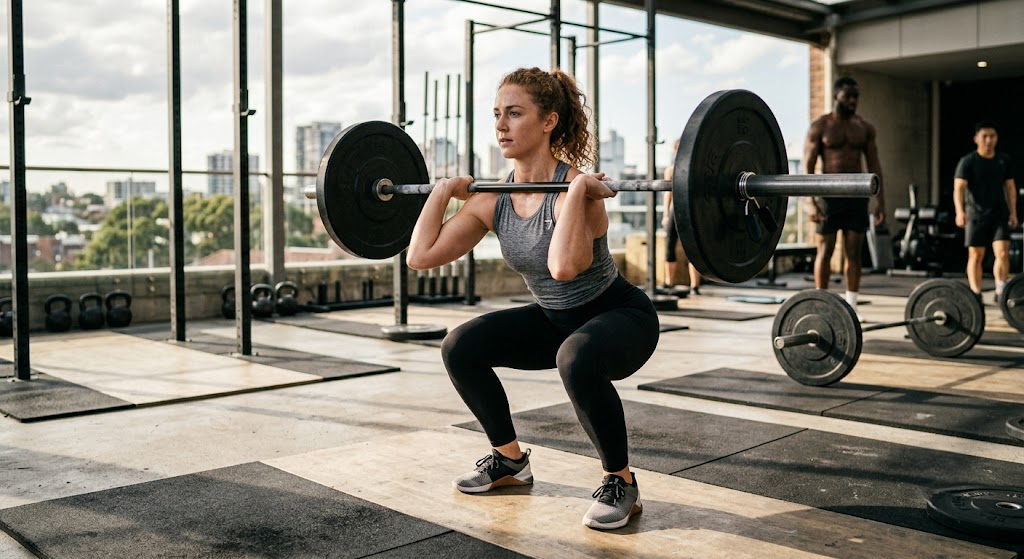
1. Squats
Reps: 10 | Muscles worked: Quads, glutes, hamstrings, core
How to do it: Stand with feet shoulder-width apart, toes pointed slightly outward. Push your hips back and bend your knees, lowering as if sitting into a chair behind you. Keep your chest up and your knees tracking over your second toe — not caving inward. Lower until your thighs are parallel to the floor (or as low as is comfortable), then press through your heels to return to standing. Pause briefly at the top before the next rep.
Beginner modification: Chair-assisted squats. Place a chair behind you, lower slowly until you lightly touch the seat, then stand back up. This teaches the correct movement pattern and builds confidence before going freestanding.
Form tip: If your heels lift off the floor, widen your stance slightly or point toes out a little more.
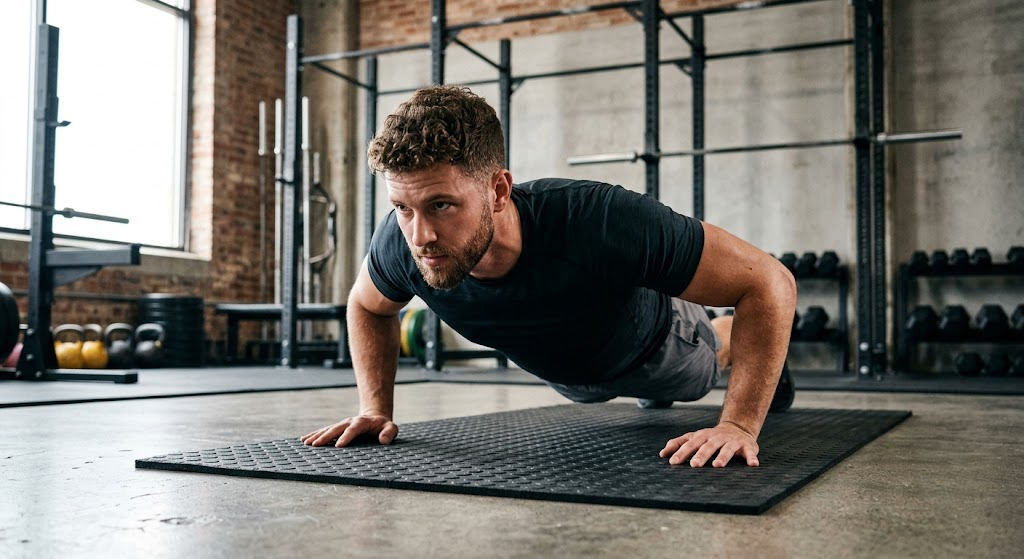
2. Push-Ups
Reps: 8 | Muscles worked: Chest, shoulders, triceps, core
How to do it: Start in a plank position with hands slightly wider than shoulder-width. Keep your body in a straight line from head to heels — no sagging hips or piked bottom. Lower your chest toward the floor by bending your elbows at approximately 45 degrees from your body (not flaring straight out to the sides). Push back up to the starting position. Keep your core engaged throughout.
Beginner modification: Knee push-ups. Drop to your knees (cross your ankles behind you for stability) and perform the same movement. This reduces the load while teaching correct upper-body mechanics. Progress to full push-ups when you can complete 10 knee push-ups with good form.
Form tip: Your body should move as a single unit. If your hips are sagging or your lower back is arching, your core isn’t engaged.
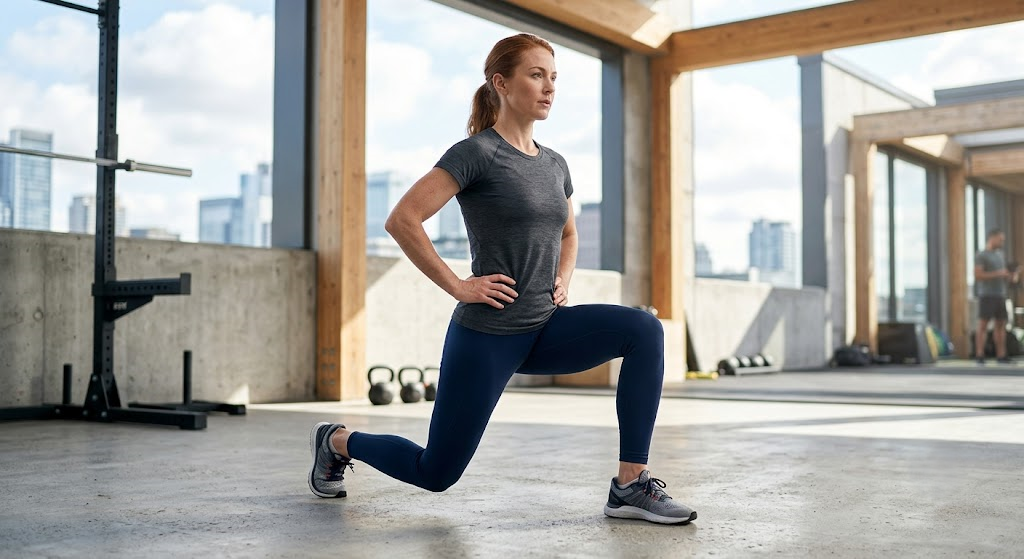
3. Reverse Lunges
Reps: 8 each leg | Muscles worked: Glutes, quads, hamstrings, balance
How to do it: Stand tall with feet hip-width apart. Step one foot directly backward and lower your back knee toward (but not touching) the floor. Your front knee should be directly over your front ankle — not extending past your toes. Push through your front heel to return to standing. Complete all reps on one leg before switching.
Beginner modification: Take a smaller step back and don’t lower as deeply. You can also hold a wall or chair for balance while you develop the coordination and strength for freestanding lunges.
Form tip: Reverse lunges are gentler on the knees than forward lunges and are the better starting choice for beginners. Keep your torso upright — don’t lean forward.
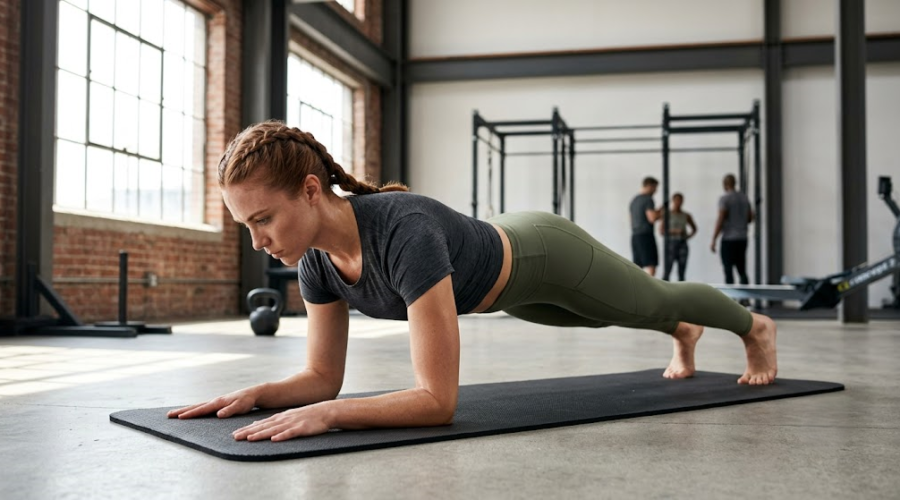
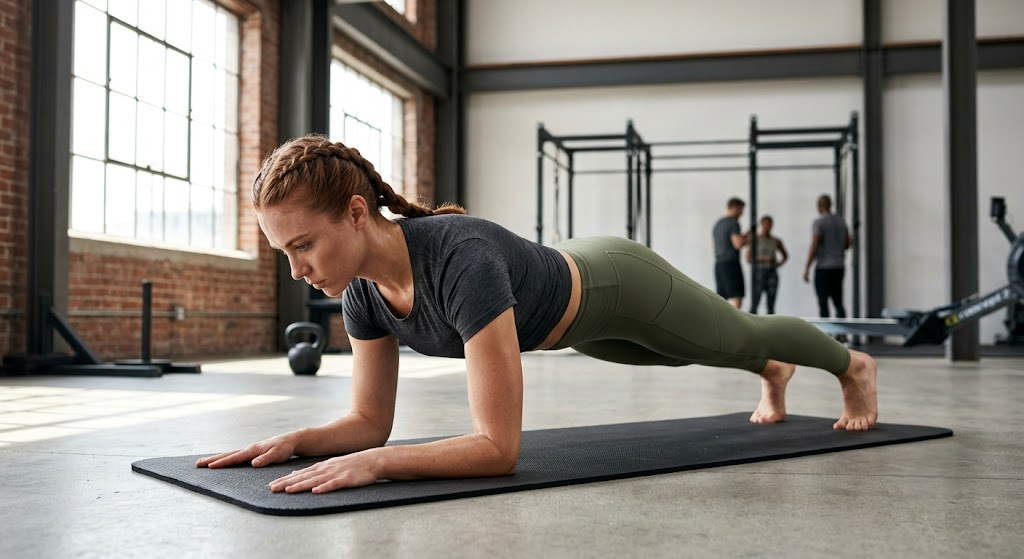
4. Plank Hold
Duration: 20 seconds | Muscles worked: Core, shoulders, back
How to do it: Place your forearms on the floor, elbows directly under your shoulders. Extend your legs behind you, balancing on your toes. Your body should form a straight line from head to heels. Engage your core, squeeze your glutes, and hold. Keep breathing — holding your breath increases blood pressure unnecessarily and makes the hold harder.
Beginner modification: Drop to your knees (keeping hips level) for a knee plank. This reduces the load while still engaging the core effectively. Build from 10-second holds and work toward 20, then 30, then 45 seconds.
Form tip: Most form breakdowns in planks are hips — they either sag toward the floor (core not engaged) or pike up too high (avoiding the work). Aim for a flat, table-top back.
5. Jumping Jacks
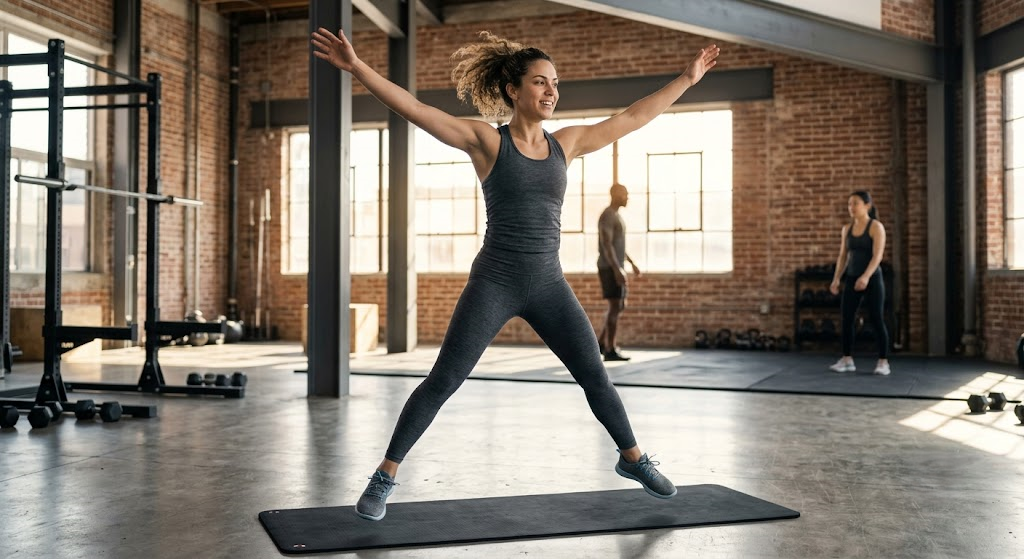
Duration: 30 seconds | Muscles worked: Full body, cardiovascular
How to do it: Start with feet together and arms at your sides. Jump feet out to shoulder-width while raising arms overhead. Jump back to start. Keep a steady, sustainable pace — this is a cardio finisher for the round, not a sprint.
Beginner modification: Step jacks. Instead of jumping, step one foot out to the side while raising the same-side arm, then return and repeat on the other side, alternating. This delivers the same cardiovascular benefit without the impact, making it ideal for people with joint concerns or those exercising on a hard floor.
Cool-Down — 2 Minutes
Never skip this phase. Stretching immediately after a workout, while muscles are warm, improves flexibility and reduces next-day soreness.
Quad stretch (30 seconds each leg): Stand on one foot, pull the other heel toward your glutes, and hold. Use a wall for balance. Feel the stretch along the front of your thigh.
Hamstring stretch (30 seconds each leg): Sit on the floor with one leg extended, the other bent. Reach toward your toes on the extended leg, keeping your back straight rather than rounding.
Child’s pose (60 seconds): Kneel on the floor, sit back toward your heels, and stretch your arms forward on the floor. Breathe deeply. This releases the lower back and shoulders that the workout compresses.
How to Progress Week by Week
Progression is what turns a workout into fitness. Without it, your body adapts and the same routine stops producing results.
Week 1: One round of all five exercises. Rest as long as needed between exercises.
Week 2: Two rounds. Begin reducing rest between exercises to 30–45 seconds.
Week 3–4: Three rounds with 60–90 seconds rest between rounds. This is the full 20-minute workout.
After 4 weeks: Increase reps (12 squats instead of 10, 10 push-ups instead of 8), reduce rest time, or hold the plank for 30–40 seconds instead of 20. This is progressive overload — the foundational principle behind all fitness progress. Your body only improves when it’s challenged slightly beyond what it’s currently comfortable with.
Common Beginner Mistakes to Avoid
Skipping the warm-up. Three minutes feels like wasted time until the day you strain a cold muscle. Non-negotiable.
Holding your breath. Particularly during planks and push-ups. Exhale on the effort, inhale on the release — or simply breathe naturally throughout.
Prioritizing speed over form. Ten squats with correct form do more than 20 sloppy ones and are far less likely to cause injury. Slow down.
Expecting visible results in two weeks. Cardiovascular improvements happen within 2–3 weeks; significant strength and body composition changes take 6–12 weeks. Impatience kills more fitness journeys than effort does.
Doing too much too soon. Starting with three full rounds on day one when your body isn’t conditioned for it leads to extreme soreness, discouragement, and skipping the next session. Start with one round and build.
How to Stay Consistent
Work out at the same time every day. Habit formation research consistently shows that consistency of timing matters as much as frequency. Morning, lunch break, or after dinner — pick one and repeat it.
Put your clothes out the night before. This sounds trivially small and works unreasonably well. Reducing the friction between waking up and starting makes you far more likely to do it.
Track with checkmarks. A paper calendar where you mark each completed workout creates a visual streak you’ll feel motivated to maintain. Don’t break the chain.
Find an accountability partner. Even a text to a friend saying “done for today” measurably improves adherence. Social commitment is one of the most powerful habit anchors available.
Celebrate small wins. Completing week one is worth acknowledging. A second push-up compared to last week is progress. The hardest part of any workout isn’t the exercise itself — it’s pressing play and starting. Once you’ve started, you’ve already won the most important battle.
Frequently Asked Questions
Is 20 minutes of exercise enough for beginners? Yes — especially at the start of a fitness journey. The American Heart Association recommends 150 minutes of moderate exercise weekly, and 20-minute daily sessions get you close to that target. More importantly, the EPOC afterburn effect means your metabolism stays elevated after a 20-minute session, extending the caloric and cardiovascular benefit beyond the workout itself. For beginners, the most important variable isn’t duration — it’s consistency. Twenty consistent minutes five days a week produces far better results than two longer sessions with days of inactivity in between.
How many times a week should a beginner work out? Three to four times per week is the ideal starting frequency for most beginners — enough stimulus to build fitness, with adequate rest days for muscle repair and recovery. Rest days aren’t passive; they’re when the body actually adapts to the training stress you’ve applied. If 20 minutes three times a week feels manageable, stick with that for the first month before increasing frequency. Overdoing it in week one is one of the most common reasons people abandon new exercise routines.
Best time of day to work out at home? The best time is the one you’ll actually do consistently. Morning workouts benefit from being completed before the day’s demands create competing priorities. Evening workouts allow for better physical performance since body temperature and muscle function are higher. Lunchtime sessions provide a mid-day energy and focus reset. Research on timing effects is real but modest — the consistency variable overwhelms them. If you’re a morning person, morning. If not, evening. The right answer is when it happens reliably.
Will I lose weight doing this workout? This workout supports weight loss as part of a broader approach that includes nutrition. Exercise alone — particularly at beginner volume — rarely produces dramatic weight loss because caloric expenditure from a 20-minute session is meaningful but modest. Where exercise genuinely contributes to weight management is through improved insulin sensitivity, preserved muscle mass (which burns more calories at rest than fat), and the behavioral momentum it creates toward other healthy choices. Most people who commit to a regular exercise habit gradually make better dietary choices as well — the two habits reinforce each other.
What to eat before and after a workout? For a 20-minute beginner session, food timing is less critical than at higher intensities. If working out in the morning, a small banana or a tablespoon of peanut butter 20–30 minutes before is sufficient. If working out 2+ hours after your last meal, a small carbohydrate-protein snack helps (Greek yogurt, fruit, or toast with almond butter). Post-workout, prioritize protein within an hour to support muscle repair — eggs, a protein smoothie, Greek yogurt, or cottage cheese all work well. Stay hydrated before, during, and after.
Start Today, Not Monday
The 20-minute home workout for beginners in this guide is specifically designed to meet you exactly where you are — no experience needed, no equipment required, no hour to spare. One round of five exercises, three minutes of warm-up, two minutes of cool-down. That’s it for week one.
The hardest part of any workout isn’t the exercise — it’s pressing play and starting. Once you’ve done that, the rest follows. Start with one round, be consistent for four weeks, and follow the progressive overload framework above — and you’ll be in a meaningfully better place physically and mentally than you are today.
Consult your doctor before starting any new exercise program, particularly if you have a pre-existing health condition, have been sedentary for an extended period, or experience pain during exercise.
Leave a Comment